Critical U.S. Events
Understanding Our Past Gives Us Insight on What Lays Ahead
Historic Democratic and Republican
Party Actions
1800's
1828 – Democratic Party was founded by Martin Van Buren and Andrew Jackson. The oldest existing party in the US and oldest voter based political party in the world. The early party was known as the party of the common man, stood for individual rights, state sovereignty, opposed banks and high tariffs. The party supported slavery and opposed civil rights reforms after the Civil War and had southern white voters’ full support.
1854 – Republican Party was founded by a group of Northern leaders due to opposition to the Kansas-Nebraska Act (opened the Kansas and Nebraska territories to slavery and future admission as slave states) and the expansion of slavery. Early party consisted of northern Protestants, factory workers, businessmen, prosperous farmers.
1860-1866 – Abraham Lincoln became the first Republican president. Under his leadership, the party successfully guided the Union to victory in the American Civil War and helped abolish slavery. After 1866, former African American slaves joined the party.
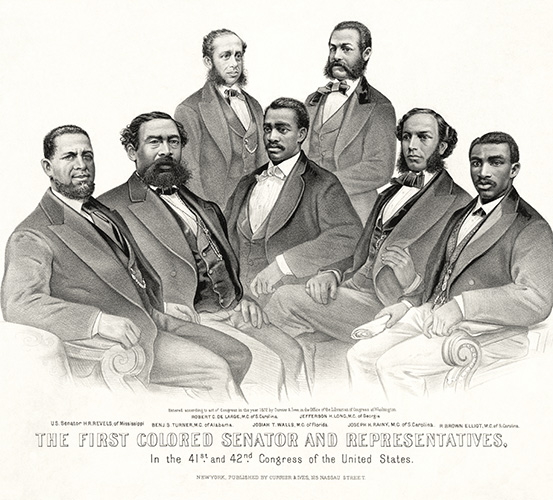
First colored senator and representatives of the 41st and 42nd Congress of the US, 1872.
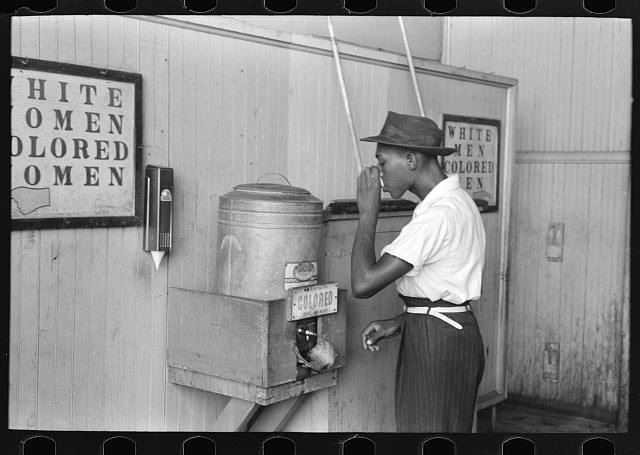
“Man drinking at a water cooler in streetcar terminal, Oklahoma City, Oklahoma.” Photo by Russell Lee, 1939.
1900's
1929-1948 – The stock market crash of 1929 and the Great Depression that followed had severe consequences for the Republicans, largely because of their unwillingness to combat the effects of the depression through direct government intervention in the economy. The Republican’s unpopular opposition to expanding the federal government’s role caused the party to lose the presidency for two decades.
1933-1936 – Democratic President Franklin D. Roosevelt implemented the New Deal program focused on job creation through public works projects, social welfare programs such as Social Security reforms to the banking systems. The Democratic Party became more closely identified with modern liberalism, which included the promotion of social welfare, labor unions, civil rights, the regulation of business and the support for farmers. Many African Americans started to shift toward the Democratic Party at this time, with
77% of the black vote going to Roosevelt for his second term in 1936.
1945-1953 – The Democratic Party, under President Harry Truman became even more highly favored by the African American community due to his order to desegregate the armed services and his executive order setting up regulations against racial bias in federal employment. Truman received 77% of the African American vote in 1948.
1953-1960 – In 1953, Dwight D. Eisenhower became the first Republican to be elected President in 24 years. A war hero, Eisenhower, was well liked by the public. His two terms didn’t produce any significant accomplishments, and his vice president, Richard Nixon, lost the 1960 presidential election to Democratic John Kennedy.
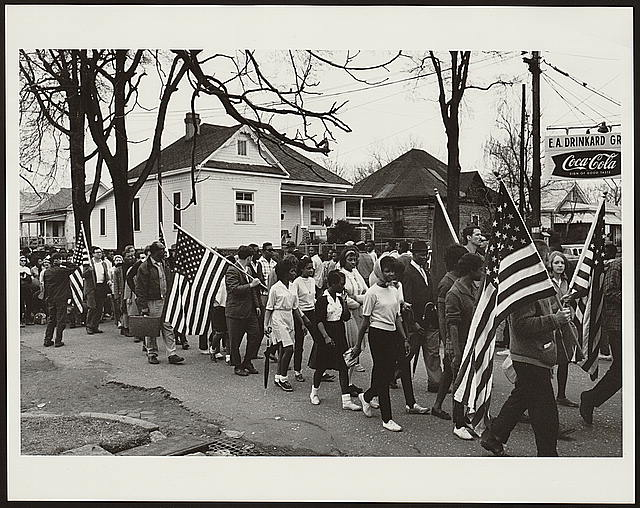
Civil rights march from Selma to Montgomery, Alabama. Photo by Peter Pettus, 1999 or 2000 from a photograph taken in 1965.
1960-1965 – Although President Kennedy was an advocate for civil rights, he was assassinated in 1963 before he could implement any major civil rights initiatives. His vice president, Lyndon Johnson became the president and signed the Civil Rights Act of 1964 (outlawed segregation in public places) and the 1965 Voting Rights Act. While this cost the Democratic party the traditional allegiance of many of its white Southern supporters, most African Americans joined the Democratic Party due to the party’s advocacy of and support for civil rights.
2000's
2008 – 2016 – First African American President, Barack Obama, was first elected in 2008 and for a second term in 2012. The Democratic party’s crowning achievement was the most significant regulatory overhaul of the US healthcare system with the passage of the Health Care and Education Reconciliation Act of 2010.
2020 to 2024 – First African American Vice President, Kamala Harris, was elected with President Joe Biden our 46th president, in 2020. The most significant legislation, The American Rescue Plan Act of 2021, was signed into law during the first 100 days of President Biden’s presidency. His administration was also successful in getting much needed vaccines to combat the pandemic out to the nation.